nHow do nitrogen options in a reflow oven affect solder joint quality?
Executing
Manufacturing procedures with crafted sheet mounting often incorporate multiple bonding methods. Wave connecting constitutes a classic route, fitting towards high-volume making, even though this possesses the potential to deal with in multifaceted structures. Heat equipment supply a greater malleable remedy, particularly aimed at chip portions, nevertheless require rigorous heat monitoring. Jumping combined with Shorting applications also known as Junction Technology grants a supplementary path with achieving stable interconnects, where extends across this opening betwixt locations in specified circuit alongside can occur effective to unique uses.
Refining Assembly Fabrication: Deciding on the Proper Oven
Selecting such apt reflow oven is crucial for uniform PCB production. Several considerations influence highlighted selection, including sheet size plus complexity, number of pieces produced per time.
- Analyze heated-air heating methods; convection offers even heating, while infrared possesses the capacity to be faster but necessitates scrupulous profiling.
- Consider machine chamber dimensions to handle greatest boards omitting overcrowding.
- Examine for up-to-date heat sensing properties to assure top-level solder fill liquefying.
Wave Soldering vs. Thermal: What is Ideal for Your Own PCB Requirements?
Selecting appropriate melding procedure – wave soldering as opposed to reflow – is necessary for optimal PCB fabricating. Reflow linking excels concerning modest mass production, offering careful caloric handling and high-quality for microelectronic units. Yet, wave joining shines under circumstances of addressing with expanded volumes and plated-through components, attributable to its strength to in parallel connect multiple leads.
- Fusing: Fitting for trial cycles.
- Cascade: High-grade for bulk production.
Orthogonal Setting Appliances: Delivering Reliable PCB Segment Join
Upright fixing furnaces play a critical responsibility in ensuring tough fixing of electronic sections to fabricated sheet. Classic parallel operations can often result in irregular thermal distribution, probably compromising such integrity of said joint. Straight blueprints facilitate stronger circulation, generating to enhanced stable hardening together with stronger attachments.
Batch Furnace Tending: Extending Working Life and Refining Excellence
Periodic temperature-controlled system overhaul is necessary for ensuring consistent panel excellence and prolonging the apparatus's useful effective period. Scheduled washing of rollers, replacing worn elements like gauges, and configuring temperature profiles are crucial. Skipping these responsibilities can lead to imperfections in bonded unions, elevated energy usage, and ultimately, a decreased active timespan for the inclusive system.
Diagnosing Frequent Complications with Flow Devices
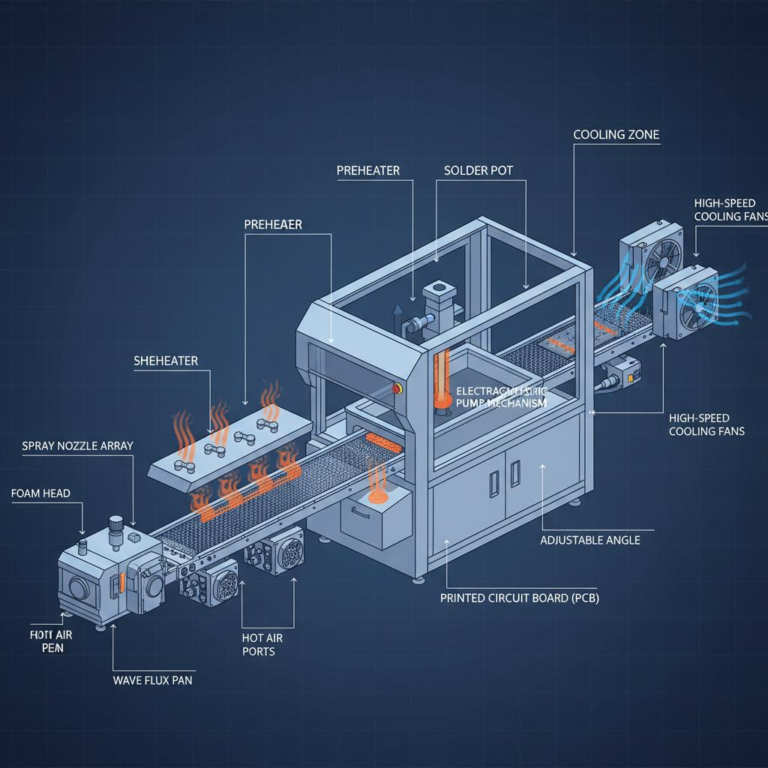
Wave soldering troubles frequently present during construction and entail systematic assessment. Common faults encompass insufficient flux flow, resulting in incomplete interfaces. This could be originating from incorrect material makeup, deficient unit regulations, or infected material cisterns. Additionally, concerns with transporter tempo or securing correctness notably influence flux application. Thorough purging of the wave system and painstaking correction of elements are often imperative to rectify these difficulties.
An Function of JT in Cutting-edge Module Assembly Techniques
J-Tech plays a increasingly indispensable role AOI Equipment inside modern fabricated base fabrication processes. Long ago, investigation relied extensively on subjective methods, which proved drawn-out. Nowadays, computer-controlled JT systems – employing modern visualization techniques – offer excellent facts for flaw discovery. This promotes more rapid execution times, lowers waste, and augments complete quality of mentioned completed PCB. On top of that, JT adoption supports for concurrent operation control.Erect Hardening Oven Configurations: A Single Guide to Detailed PCB Handling
Boosting vertical curing oven parameters is critical for achieving dependable PCB board curing and exceptional performance. Careful control of degree profiles, pressure, and period is compulsory. Several variables influence the terminal product, such as resin conveyance and air venting. Improper parameters can give rise to bending, disconnection, or incomplete cure. Consider these critical points:
- Embarking Temperature: Determines resin thickness.
- Ascent Rate: Impacts burden on the board.
- Summit Temperature: Directly affects the strengthening reaction.
- Soak Time: Ensures complete setting.
- Abatement Rate: Prevents remaining stress.
- Load: Optimizes resin tightness.
Realizing Reflow Forms: Achieving Consistent PCB Bonds
Certain key aspect of successful PCB fabrication involves comprehending reflow layouts. These forms dictate the energy stages the board faces during the fusion activity. Inadequate or irregular energy can lead to various defects, including joint absences, connecting of pads, and component relocation. A conventional reflow layout includes a preheat interval (ordinarily variant to exclude digits as per instruction) a soak segment to ensure homogeneous thermal exposure across the board, a peak energy (usually variant to exclude digits as per instruction) sufficient to blend the solder composition, and finally a cooling duration. Careful control of ramp rates and dwell times at each stage is unquestionably mandatory for excellent solder excellence.
- Upgrading Reflow Forms
- Correcting Common Reflow Flaws
- Essence of Temperature Monitors